Ingredient profile
Palmitoylethanolamide (PEA) in SciatiEase: 500 mg per Serving, Set Against the Research
Palmitoylethanolamide (PEA) is a fatty acid amide that the body also makes, sold as a nerve comfort supplement. SciatiEase lists 500 mg of PEA per 4 capsules, or 250 mg per 2. A 3-week sciatica trial used 300 or 600 mg a day, and a meta-analysis found about a 2-point drop on a 10-point pain scale across small trials.
Written by the SciatiEase label deskUpdated
The basics01
What is palmitoylethanolamide (PEA)?
Palmitoylethanolamide, or PEA, is a fat-based molecule that your own body makes. As a capsule, it is sold for nerve comfort.
It is not a vitamin, an herb or a drug. In the United States it is sold as a dietary supplement. It also has nothing to do with pea protein; the letters are short for the chemical name.
Where PEA sits on the label
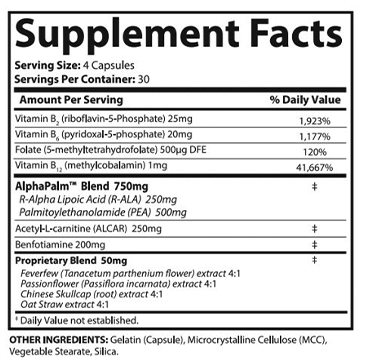
The panel prints PEA inside the AlphaPalm™ Blend, 750 mg in total: R-alpha lipoic acid 250 mg plus PEA 500 mg. Both amounts are printed, so nothing about PEA is hidden.
At 500 mg, PEA is the largest line on the panel. It outweighs every vitamin, the lipoic acid and the whole herb blend.
Dose02
How much PEA is in SciatiEase?
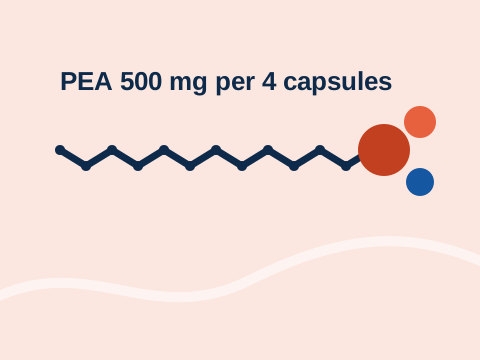
SciatiEase holds 500 mg of PEA per 4-capsule serving, or 125 mg in each capsule. Take 2 capsules and you get 250 mg.
The sales page starts with 2 capsules at breakfast and adds 2 at dinner for the full serving (SciatiEase sales page). Only the full serving lands inside the trial range. Ask your doctor before taking more than the label serving; timing tips are on how to take SciatiEase.
| Name on the label | Palmitoylethanolamide (PEA) |
|---|---|
| What it is | A fatty acid amide the body also makes |
| Group on the label | AlphaPalm blend |
| Amount per 4 capsules | 500 mg per 4 capsules |
| Amount per 2 capsules | half of that |
| Amount used in research | 300-600 mg a day in a 3-week sciatica trial |
| Strength of evidence | Small trials; some pain-score benefit |
| Marketed or traditional use | Sold for nerve comfort |
| Main caution | Generally well tolerated in trials; long-term data are limited. |
Research03
Does PEA help sciatica pain in studies?
PEA has some study support for pain, but the evidence is thin. A 2017 meta-analysis of small trials found pain scores about 2 points lower on a 10-point scale than in control groups (Artukoglu et al., Pain Physician 2017).
The authors rated study quality as generally poor, and two co-authors worked for a PEA company (Artukoglu et al., Pain Physician 2017).
One trial looked at sciatica directly: 636 people took micronized PEA at 300 or 600 mg a day for 3 weeks. A reanalysis found better pain and function than placebo, most at 600 mg (Cruccu et al., CNS Drug Targets 2019). It tested PEA alone. No trial has tested SciatiEase.
| Study | People | PEA dose | Finding | Limits |
|---|---|---|---|---|
| Meta-analysis, 2017 (Artukoglu et al., Pain Physician 2017) | 786 on PEA, 512 controls; mixed pain | Varied | About 2 points lower pain out of 10 | Small, low-quality trials; industry-linked authors |
| Sciatica trial, reanalysed 2019 (Cruccu et al., CNS Drug Targets 2019) | 636 with back pain and sciatica | 300 or 600 mg a day, 3 weeks | Better pain and function than placebo | Only 3 weeks; pain groups set after the fact |
The bars set each main label amount against the studied doses. PEA is the one line that reaches its range.
Form04
Is the PEA in SciatiEase micronized?
The label does not say. It names palmitoylethanolamide at 500 mg and gives no particle size or supplier.
The sciatica trial used micronized PEA, ground into very fine particles (Cruccu et al., CNS Drug Targets 2019). So the amount matches the research, but the form is unknown. Ask the order desk at +1 (844) 361-1273 if that matters to you.
- Printed: the name and the 500 mg amount
- Not printed: particle size, supplier or a lab test
SciatiEase: from $49.99 a bottle120 capsules · 1, 3 or 6 bottles · 180-day money-back guarantee
See packsSafety05
Is PEA safe to take every day?
PEA was generally well tolerated in trials, but long-term data are limited. The sciatica trial ran only 3 weeks (Cruccu et al., CNS Drug Targets 2019).
The clearer cautions in SciatiEase come from its other lines: drowsiness from passionflower (NCCIH, Passionflower) and slower clotting from feverfew (NCCIH, Feverfew). We found no verified study of PEA with common medicines, so tell your doctor about every supplement you use (NCCIH, Using Supplements Wisely).
Do not stop or cut any prescribed medicine because you start PEA. Sciatica with weakness in both legs, numbness around the genitals or bottom, or new bladder or bowel trouble needs emergency care (AANS, Cauda Equina Syndrome). More on side effects.
Fit06
Is PEA a good nerve pain supplement for sciatica?
PEA is the best-studied line in SciatiEase for back and leg pain, but it is a modest option. Expect small changes at best, judged over weeks.
Sciatica often eases within 4 to 6 weeks, and staying active comes first (NHS, Sciatica). Guidelines put heat, massage and exercise ahead of pills (Qaseem et al., ACP guideline 2017). Background is on sciatica basics.
PEA is the strongest part of the formula on paper. Two capsules give 250 mg, just under the lowest trial arm, so the full 4-capsule serving is the amount that matches the study.
Which SciatiEase ingredient should you read next?
Read R-alpha lipoic acid next, since it shares the AlphaPalm blend with PEA.
Each profile follows the same order: label amount, studied dose, cautions. All 12 lines are on the ingredients overview.
FAQ07
PEA questions, answered from the label
What is palmitoylethanolamide used for?
Palmitoylethanolamide is mainly sold for pain and nerve comfort. Small trials in back pain, sciatica and other pain found about a 2-point drop on a 10-point scale (Artukoglu et al., Pain Physician 2017). In the US it is a supplement, not an approved medicine.
Is 500 mg of PEA a high dose?
No. 500 mg a day sits inside the 300 to 600 mg range of a 3-week sciatica trial (Cruccu et al., CNS Drug Targets 2019). SciatiEase reaches it only at the full 4-capsule serving; 2 capsules hold 250 mg.
Is PEA the same as pea protein?
No. PEA stands for palmitoylethanolamide, a fat-based molecule your body makes. It has no link to peas or pea protein powder.
How long does PEA take to show an effect in studies?
The sciatica trial measured results after 3 weeks of daily PEA (Cruccu et al., CNS Drug Targets 2019). No study tracked longer use at this dose, so judge any change over several weeks with your doctor.
Can I take PEA if I already use gabapentin or pregabalin?
Ask your doctor or pharmacist first. We found no verified PEA interaction study, and SciatiEase also holds passionflower, which can add drowsiness (NCCIH, Passionflower). Keep taking gabapentin exactly as prescribed.
Can I buy PEA on its own instead of SciatiEase?
Yes, PEA is sold alone as a supplement. SciatiEase pairs it with lipoic acid, ALCAR, benfotiamine, four B vitamins and herbs. Compare labels with your doctor before choosing.
Who wrote this08
Written and reviewed by
Pages built from the Supplement Facts panel, the brand pages and linked NIH, FDA, FTC, NHS and peer-reviewed sources.
Last updated . See our editorial standards and the way we check reviews. This website is run by Isciatiease, a U.S. desk for SciatiEase, not by the manufacturer or by SciatiEase Labs. Purchases made through our order links earn us a commission.
Keep reading
More about SciatiEase
U.S. desk for SciatiEase
Ready to try SciatiEase?
Check your medicines first, then pick a pack. Bigger packs cost less per bottle, and the 180-day money-back guarantee gives you time to judge it.
- Secure checkout on the brand page
- 180-day guarantee
- Ships from the U.S.